
Planning a resort expansion for 2027? Why Q4 is your window to lock in production slots
Approvals and funding for overseas resort projects cluster between Q4 and Q1 of the following year, while factory schedules and the Spring Festival holiday eat into early-year capacity. A backward-planned timeline helps you finish installation before peak season.
Every Q4, we have the same conversation with camp and resort clients: “Will our rooms be ready before next peak season?”
The answer is largely decided the moment you place your order. This article lays out the backward timeline for a 2027 delivery and explains why ordering in Q4 and locking in a production slot is the key move to finish before the 2027 peak season.
1. Your approval cycle and the factory’s production cycle fall in the same window
Funding and approval for overseas resort projects usually land between Q4 and Q1 of the following year:
– Q4: annual budget approval, next year’s capex locked, site leases and permits pushed forward. This is when owners make expansion decisions.
– Q1 of the following year: design freeze, contracts signed, deposits paid. This is when orders actually land.
The problem is that the factory’s schedule doesn’t follow your budget cycle:
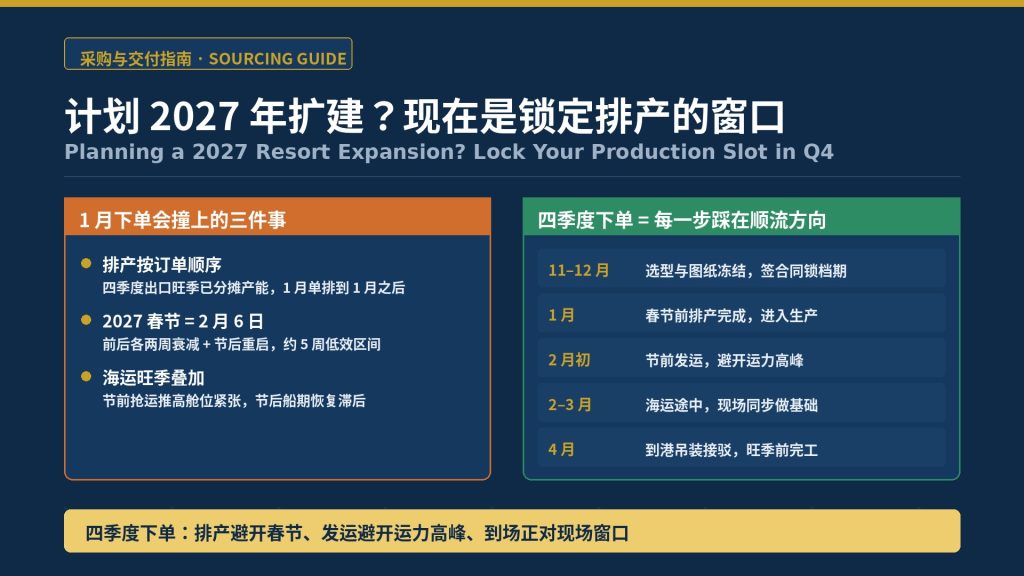
1. Production runs in order of orders received. Q4 is itself peak export season (restocking before Christmas, rush shipping before the holiday), so factory capacity is split across many orders. An order placed in January can only take slots after January.
2. Spring Festival 2027 falls on February 6. About two weeks on either side is a low-efficiency period, and with workers returning and supply chains restarting after the holiday,actual effective capacity from early February to early March is very limited. Spring Festival isn’t “7 days off” but roughly a 5-week low-efficiency stretch (see our upcoming Spring Festival calendar article for the day-by-day breakdown).
3. Ocean freight peak overlaps. The pre-holiday shipping rush tightens space, and sailings recover slowly after the holiday.
Put the three together:projects ordered in January will most likely enter production after March, pushing shipping and on-site work further back, and eating a big chunk of the buffer you need to finish before peak season.
2. A backward timeline: from “open for peak season” back to “order now”
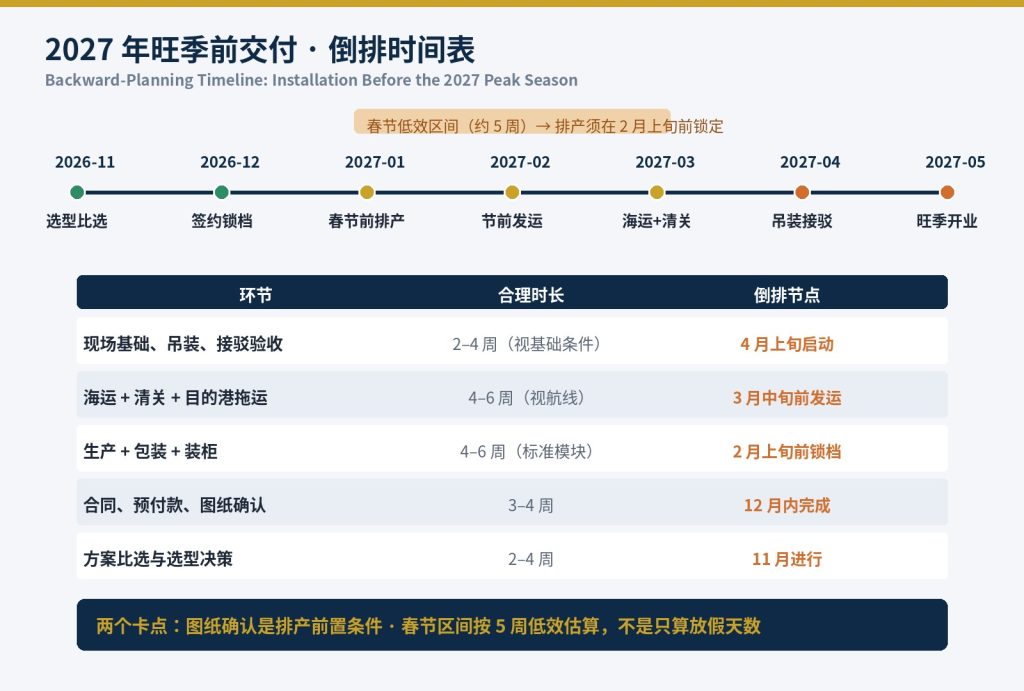
Backward timeline for delivery before the 2027 peak season
Assume your goal is to finish installation before the May 2027 Golden Week(the start of peak season in most resort areas). Working backward:
| Stage | Reasonable duration | Backward milestone |
| Site foundation, lifting, hookup and acceptance | 2–4 weeks (depending on site conditions) | Start early April |
| Ocean freight + customs clearance + haulage from port of destination | 4–6 weeks (depending on route) | Ship by mid-March |
| Production + packing + container loading | 4–6 weeks (standard modules) | Lock production slot by early February |
| Contract, deposit and drawing confirmation | 3–4 weeks | Complete within December |
| Option comparison and selection decisions | 2–4 weeks | Held in November |
Watch out for two critical bottlenecks:
– Drawing confirmation is a prerequisite for scheduling production. If the layout, doors and windows, and interior fit-out specs aren’t locked in, the factory won’t reserve a production slot. That’s why selection decisions belong in November, not left to be revised slowly after the contract is signed.
– Early February to early March is the low-efficiency window around Spring Festival. If production gets pushed into this period, estimate the actual completion date using the 5-week low-efficiency window, not the number of calendar holiday days.
Projects ordered in Q4 are a completely different story:production is scheduled before Spring Festival, shipping goes out before the holiday to avoid the freight peak, and goods arrive after the holiday right as site foundation work begins— every step moves with the current of available capacity and logistics.
3. Four things to confirm with your supplier when locking in a production slot
1. What counts as the official slot? Scheduling confirmation should be based on a written production scheduling letter (including the date the deposit clears). A verbal slot is not a capacity commitment.
2. How should delivery terms around Spring Festival be written? Have the supplier put the pre-holiday shipping cutoff and the post-holiday production restart date in a contract appendix, rather than a vague “4–6 weeks.”
3. Who books the ocean freight space? Space is tight before Spring Festival, so the terms should clearly state who is responsible for booking and how costs are handled.
4. Drawing freeze date. Write the design confirmation deadline into the contract as a milestone. Changes after that date are treated as extensions—this protects both sides.
4. Weiland’s capacity and scheduling approach
– 8,000 sq m production base, with in-house lines covering every process from light-gauge steel framing to finished modules; standard modules take 4–6 weeks to produce;
– Written scheduling letters: once the deposit clears, we issue a written scheduling letter locking in the start date and estimated shipping date;
– Spring Festival scheduling: every November–December we rank orders on hand by pre-holiday shipping priority, so customers can plan site foundations and crane crews accordingly;
– Track record on past projects: the Dunhuang desert camp delivered 12 units within a single season, and the Ganzi cliff hotel finished on schedule despite transport constraints—our scheduling commitments are backed by actual delivery records.
If your 2027 budget already includes an expansion plan, now through mid-December is the window to lock in pre-Spring Festival capacity. Send us your site’s climate conditions, target opening date and intended unit count, and we’ll give you an actionable scheduling recommendation based on a countdown timeline.Contact Us