
Behind the prefab housing order surge: three export signals from Canton Fair Phase 2
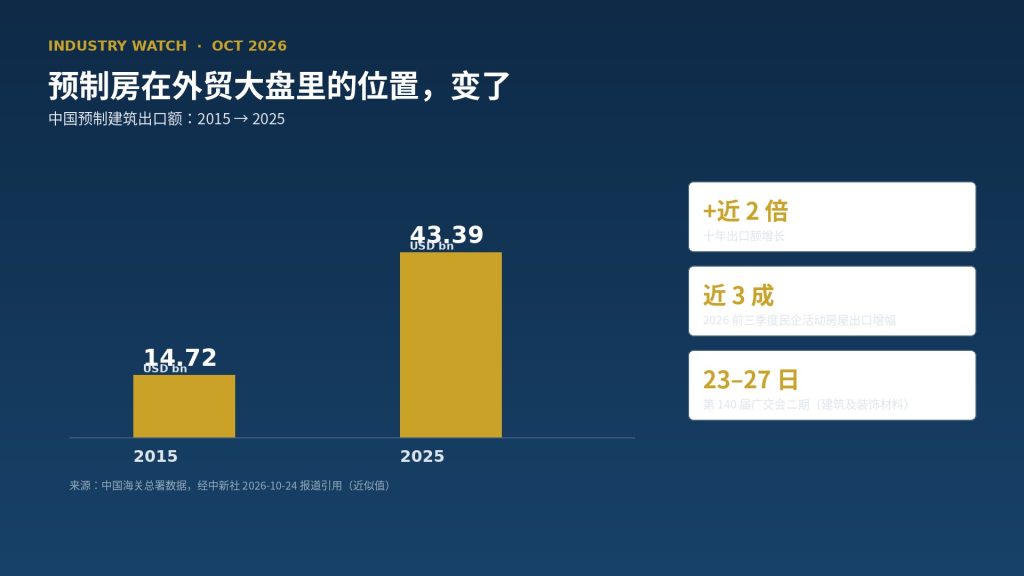
China’s prefab construction exports, 2015-2025, and key figures from Phase 2 of the 140th Canton Fair
Prefab housing orders surge at Canton Fair: three export signals and shifting buyer behavior
Meta Description: ** Notes from the prefab housing section at Phase 2 of the 140th Canton Fair: China’s prefab construction exports grew from $1.47 billion to about $4.34 billion over ten years, and private firms’ exports of movable housing rose nearly 30% in the first three quarters. Buyers are moving from single products to full solutions and from buying stock to booking production slots. What this means for Chinese suppliers.
Slug:** `canton-fair-prefab-export-signals-2026`
Keywords: China prefab export trend; modular housing Canton Fair 2026
Structured data: ** Article + FAQPage
──────────────────────────────────────────────
At Phase 2 of the 140th Canton Fair, held October 23-27 in Guangzhou, prefab housing was one of the most talked-about categories in the building and decoration materials section. This low-key industry trade fair actually sent three signals worth noting for both exporters and overseas buyers, all backed by verifiable data from the General Administration of Customs of China and China News Service’s on-site reporting.
1. Two hard numbers first
China’s prefab construction exports have nearly tripled in ten years. Data from the General Administration of Customs of China shows that from 2015 to 2025, China’s prefab construction exports grew from $1.472 billion to about $4.339 billion (cited in a China News Service report on October 24, 2026).
In the first three quarters of 2026, private firms’ exports of movable housing of all kinds grew nearly 30%. At an October 14 press conference held by the State Council Information Office, Wang Jun, Vice Minister of the General Administration of Customs, cited prefab tent housing packed and shipped in batches as modular components as an example of private firms’ keen insight into market demand, grouping it with the global boom in glamping and outdoor vacations.
Put these two numbers on the same chart and the direction of the trend needs no explanation: prefab housing has grown from a niche category into a new track in China’s foreign trade that officials now name explicitly.
2. On the show floor: three shifts in buyer behavior
Beyond the numbers, the more noteworthy change at the fair was in buyer behavior. Based on China News Service reporting and exhibitor feedback, there are at least three layers:
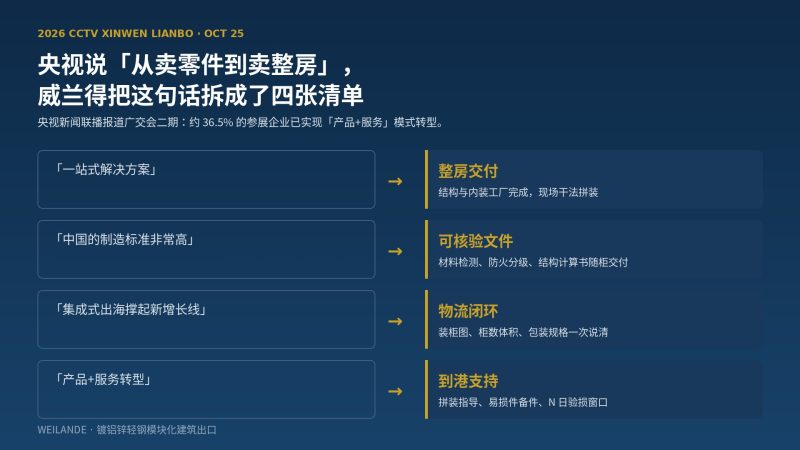
1. What they buy: from single products to full solutions. A US buyer said in an interview that sourcing all the building materials for a whole house in one place is now the mainstream trend in overseas procurement. The same holds for prefab housing: selling a house is no longer just quoting a price for a box. Bathrooms, flooring, beds and interior fittings are bundled into the solution, and buyers evaluate quotes on whether the unit is ready to use on arrival.
2. Who buys: from individual buyers to institutions and projects. At the show, one exhibitor sold more than ten units in two days and is negotiating a single order for 50; buyers came from Mexico, South Africa, Bulgaria and Romania, with demand concentrated in hotels, senior-living apartments, offices and mining camps. The Bulgarian buyer was reordering for employee dormitories, while the Romanian buyer was drawn by the delivery efficiency of Chinese prefabricated housing amid high overseas labor costs. Inquiries from individual buyers for single units continue, but the deal mix has clearly shifted toward project-based purchasing.
3. How to buy: stop thinking in stock, start thinking in production slots. One exhibitor’s expandable homes are booked out for six months. Buyers increasingly ask not “Do you have stock and what’s the price?” but “How far out is your production schedule, and can you hit my project milestones?” —delivery capacity has itself become a purchasing variable.
III. What this means for overseas buyers: lock your slot early
Under this production-slot mindset, the thing buyers most need to adjust is their timeline. Show buzz usually takes weeks to months to reach the factory floor: once inquiries rise, production slots, raw material stockpiling and shipping schedules all tighten. A few practical tips:
– For peak-season projects (especially spring construction starts in the Northern Hemisphere), lock in a production slot 2–3 months ahead, and keep price negotiation and slot confirmation separate — secure the slot first, work out the details later;
– When you inquire, give the quantity, target port and expected arrival month up front, so the factory can judge whether it can schedule your order — “just asking roughly” is the least efficient approach when production cycles are tight;
– Shipping congestion around Christmas and the pre-Spring Festival rush window (next year’s Spring Festival falls in mid-February; the 10-30 delivery-cycle article will cover this in detail) both need to go into your project plan.
IV. What this means for Chinese suppliers: the selling points are shifting
The show signals are also a reminder to suppliers:“Low price” is giving way to “predictable delivery.” China News Service observes that “Chinese home goods going global have moved past low-price, homogeneous competition and toward a contest of brand strength and long-term service capability.” In the prefab housing category, buyers will pay a premium for three things: verifiable compliance documents (materials, fire safety, structural calculations), a clear delivery timeline, and assembly support after arrival at port. These three are exactly what export companies have been least likely to put in their quotations over the past decade.
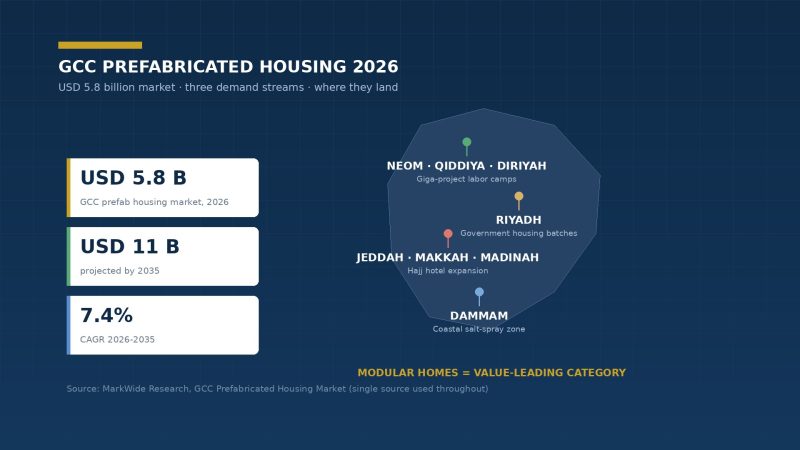
Demand in the global market has not slowed: Europe’s modular and prefabricated agenda (see the 10-13 summit article) and the Middle East’s affordable housing and camp demand (see the 10-25 GCC article) are both growing. Trade shows are where demand becomes visible, but orders ultimately flow to the production lines that can deliver.