
GCC Prefabricated Housing to Hit $5.8B in 2026: Mapping Middle East Demand
Where Prefabricated Housing Demand Sits in the Middle East
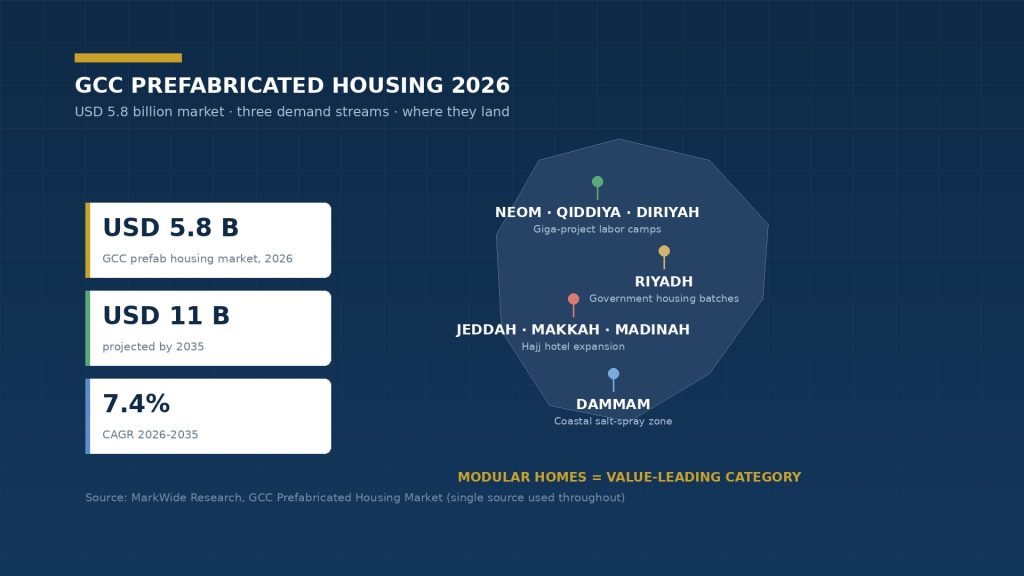
GCC prefabricated housing will be worth about $5.8 billion in 2026 and about $11 billion by 2035, a CAGR of roughly 7.4%. Three demand types — mega-project labor camps, Hajj hotel expansion, and government affordable housing delivered in batches — each want something different. Here is what they need, and which gap exporters should close first.
Slug:** `gcc-prefabricated-housing-2026-middle-east-demand`
Keywords: GCC prefabricated housing market; Saudi Vision 2030 modular housing
Structured data: ** Article + FAQPage
──────────────────────────────────────────────
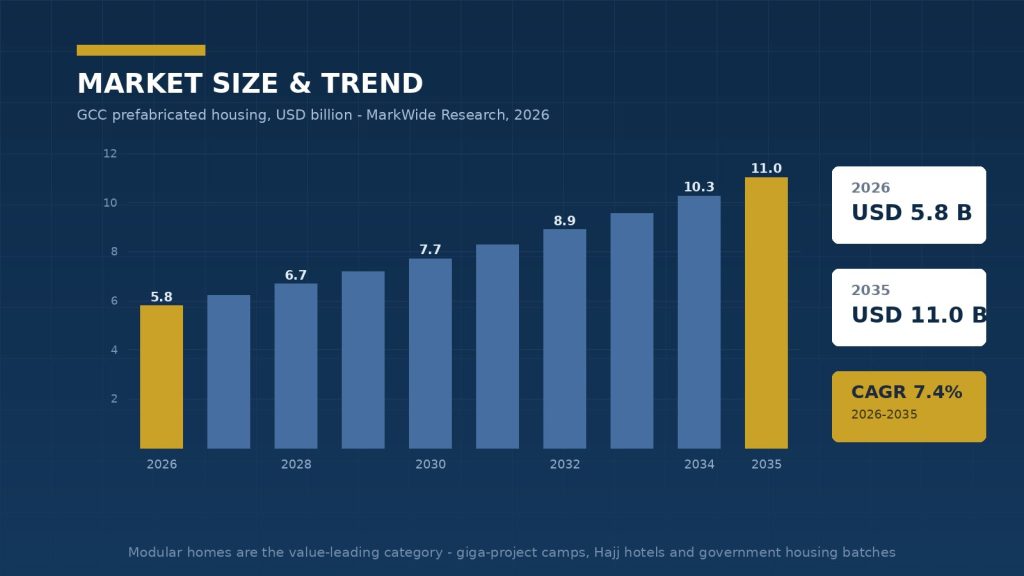
GCC prefabricated housing market size and trend chart
1. Market size: one source, two numbers
According to MarkWide Research’s 2026 report,the GCC prefabricated housing market will be worth about $5.8 billion in 2026 and is expected to reach about $11 billion by 2035, a compound annual growth rate of about 7.4% from 2026 to 2035~7.4% CAGR. Modular homes are the highest-value category — mega-project labor and operations camps and hotel expansion both need replicable, customizable volumetric modules, not one-off site-built construction.
One caveat: research firms define and measure “prefabricated housing” differently (whether panelized systems, mobile homes, and container conversions are included),so this article uses MarkWide Research figures only and cites the source throughout, without mixing or comparing them with other firms’ numbers.
2. Demand map: three demand types, three buying logics
1. Mega-project labor camps: fast, standard, relocatable
Saudi mega-projects such as NEOM, Qiddiya, and Diriyah keep generating huge demand for construction and operations staff housing. This kind of procurement has three traits:
– Large batches, urgent delivery: units arrive in batches that follow the construction schedule, and delivery milestones move with the project;
– Standardization first: the more uniform the unit types, the faster production ramps up and the faster on-site lifting goes;
– Relocatable and expandable: once a project finishes, the camp has to move or be converted, so how easily modules can be dismantled and reassembled is a hard requirement.
What this implicitly demands of suppliers is stable capacity and batch-to-batch consistency, not standout design for a single unit.
2. Hajj hotel expansion: density, fire safety, fixed timelines
Demand for lodging in Mecca and Medina spikes during Hajj season, and hotel expansion projects are bound by the religious calendar — opening dates cannot slip. These projects want three things from prefabricated housing:
– Fire rating: for high-rise hotel use, component fire performance is a condition of entry, and Class A fire resistance is the usual threshold;
– Rooms per unit of floor area: land is expensive and plots are tight, so module dimensions must match the guest room module precisely;
– Schedule you can commit to: factory prefabrication cuts on-site work down to lifting and interior fit-out, which is what lets an opening date go into a contract.
3. Government affordable housing, delivered in batches: cost, compliance, localization
Saudi Vision 2030’s housing program has the government delivering subsidized homes in bulk. Demand is huge and unit price is sensitive:
– Cost control: under batch procurement, cost per square meter is the key metric, and factory production is exactly where prefabrication has its native advantage;
– Code compliance: must pass the Saudi Building Code (SBC, which shares its roots with the IBC system) and the relevant SASO certifications;
– Climate fit: summer highs around 50°C, intense sunlight, and dust in some regions put enclosure and structural materials directly to the test.
3. Practical advice for exporters: get weather and fire certification sorted first
The Middle East is not “just another sunny market.” In batch purchases that routinely run into tens of thousands of square meters, the cost of returns and rework caused by missing certification far exceeds the cost of the certification itself. Suggested priority:
1. Fire certification first: tenders for hotel and camp use generally make component fire rating a qualification requirement, and Class A fire rating is the threshold that applies across uses, so get the documents in place before you bid;
2. Put weather resistance in the contract: structural coating specs (such as S550GD + AZ150, explained in the October 23 materials article) and roof snow and wind load values (method covered in the October 24 loads article) should be technical annexes to the contract, not verbal promises;
3. Plan for shipping and lifting: module dimensions fitting 40-foot containers and local lifting equipment capacity must be checked at the quotation stage, otherwise schedule commitments mean nothing.
4. What Weiland can offer in the Middle East
The C520 (/products/c520-2/) container module house and the FT400 (/products/ft400-2/) functional building are the two common options for Middle East batch projects: the first suits camp and quick-install hotel rooms, the second covers functional units such as bathrooms, kitchens and duty rooms. These two capabilities map one-to-one onto the three points above: structural materials are supplied to S550GD + AZ150 with batch MTCs attached; a Class A fire-rated material system runs through the wall, roof and floor construction; modules are designed to shipping dimensions, and the lifting plan is calculated at the quotation stage.
Want to know what fits your Middle East project? Contact the export team Contact Us to request configuration lists and sample fire and material documents for camp or hotel use.