
Canton Fair 2026: From Selling Parts to Selling Whole Homes — How Weilande Delivers End to End
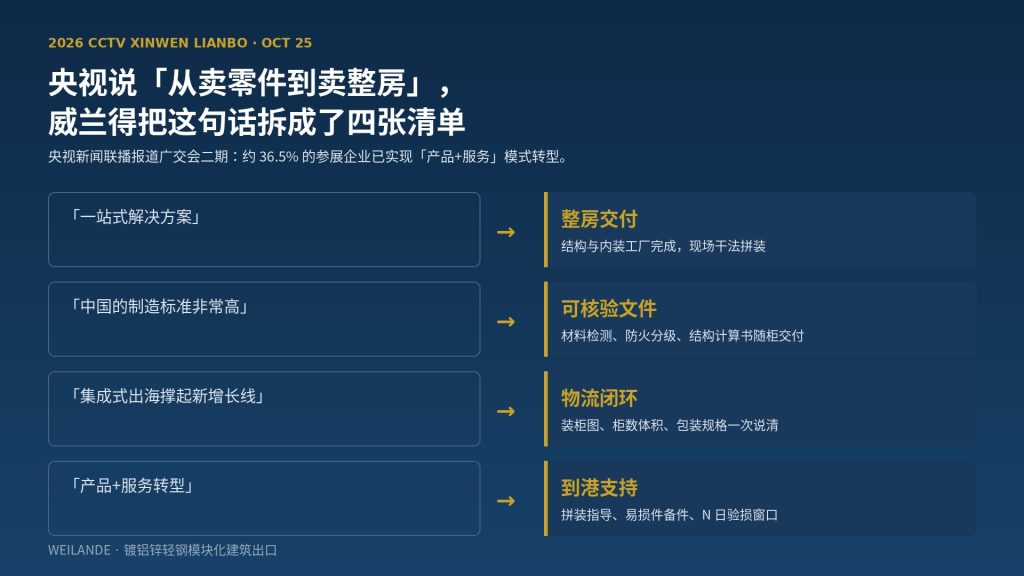
What CCTV’s News Broadcast Reported, Mapped to Weilande’s Four Delivery Checklists
On October 25, 2026, CCTV’s News Broadcast reported on the 140th Canton Fair: about 36.5% of exhibitors have shifted to a “product + service” model. Weilande breaks “end to end” into four checklists — product, documents, logistics and service: whole-home delivery, verifiable documents, a container-loading plan that closes the logistics loop, and on-arrival assembly support, explained item by item.
Slug:** `cctv-canton-fair-integrated-export-weilande-response`
Keywords: integrated prefab housing export; one-stop modular building supplier
──────────────────────────────────────────────
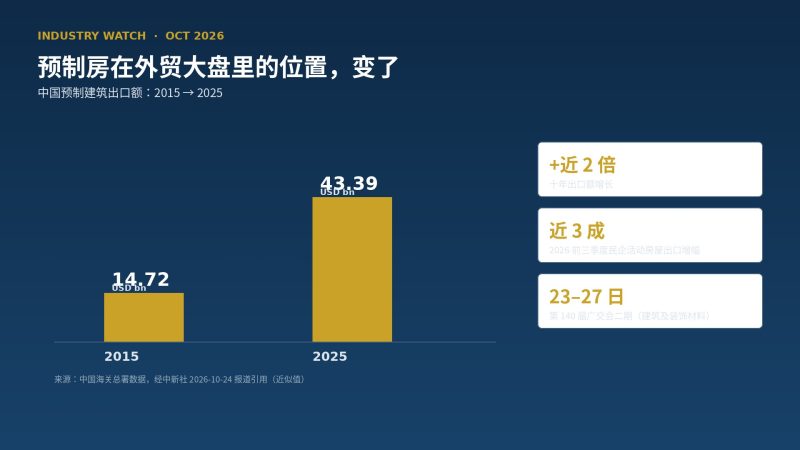
On October 25, 2026, CCTV’s News Broadcast reported on phase two of the 140th Canton Fair: space capsules, portable integrated kitchens, modular homestay units and other prefabricated products were shown together. “From selling parts to selling whole homes, integrated exports are propping up a new growth line” — and it gave one figure:About 36.5% of exhibitors at this Canton Fair have made the shift to a “product + service” model.
This report deserves serious attention, because it is not one company’s marketing language — it is an official confirmation of where the industry is heading. The problem is that “end to end” and “product + service” can mean very different things depending on which supplier is saying them. This article takes the key phrases from the CCTV report one by one and sets out exactly what Weilande does and delivers under each — so that “end to end” becomes a checklist you can verify item by item, not a slogan.
1. “One-stop solution” → whole-home delivery: how much is finished at the factory
Canadian buyer Christopher said in the report: “There is a one-stop solution here, and China’s manufacturing standards are very high.” CCTV summed up what these products have in common as “from selling parts to selling whole homes.”
For Weilande, the line for a “whole home” is clear:Structure and interior finishes are completed at the factory; on site, only dry assembly and connection of interfaces remain. The steel frame (S550-AZ150 zinc-aluminum coated light steel), insulation, interior finish surfaces, and plumbing and electrical lines are all integrated at the factory. Shipping uses flat-pack or fully assembled form to suit the project, and there is no wet work on site. The 12 units of the Dunhuang desert camp project (see the October 26 case study) were completed this way within a single construction season. The essence of “selling whole homes” is moving on-site schedule and quality problems that you cannot control into a factory environment where you can.
2. “China’s manufacturing standards are very high” → standards must be verified with documents, not adjectives
“High standards” is the buyer’s impression. In a purchase contract, it has to be a stack of documents you can check page by page. The document package Weilande ships with each container includes:
– Material test reports: steel coating and base metal performance (yield strength and coating weight for S550-AZ150, per AS 1397 / EN 10346 / ASTM A792);
– Fire rating documentation: fire performance of wall and roof assemblies, to EN 13501 or AS 1530.4 and other standards as required by the destination country;
– Structural calculations: calculations specific to your project’s wind and snow loads (see the load article, 10-24), not a generic sample;
– Factory certificates and packing lists: container numbers matched to panel numbers one to one, so any damage can be traced to the exact piece.
At the show, buyers said they “hold high expectations for Chinese manufacturing standards” — and the higher the expectation, the more the paperwork matters.When a factory’s reports are complete, buyers don’t have to judge quality on impressions.
3. “Integrated overseas expansion is a new growth line” → logistics is part of the solution, not an afterthought
CCTV called “integrated overseas expansion” a new growth line for the industry. But what actually makes it work is certainty in logistics — the vaguest part of export orders in the past. In Welland’s quotes, logistics isn’t a line saying “freight charged separately.” It’s:
1. Container loading plans based on measured pack sizes: number of containers, volumetric weight and stack pattern, all stated up front (method in the loading article, 10-27);
2. Packing specification lists: moisture barrier film, cushioning layers, pallet corner protectors and strapping, each layer spelled out;
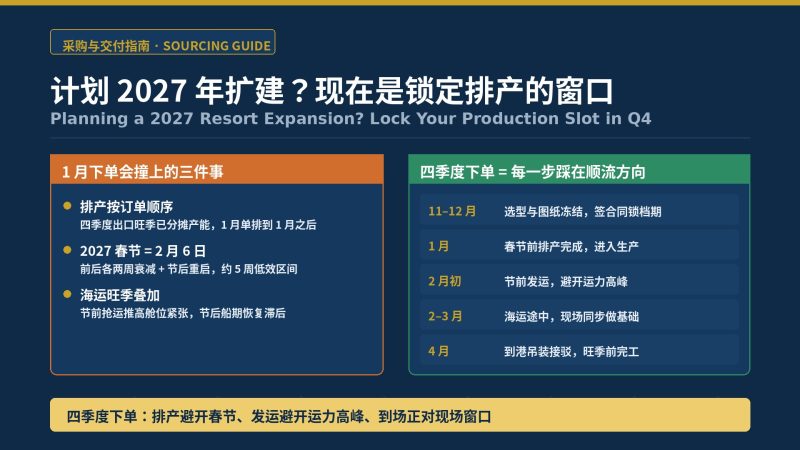
3. Shipping schedules and arrival milestones: production lead times and shipping windows locked in early (scheduling strategy in the Canton Fair article, 10-29);
4. Incoterms and cost boundaries: FOB / CIF / DDP responsibilities divided in writing in the contract, with destination port charges itemized.
4. “Product + service transformation” → service has to carry through after arrival
That 36.5% shows “product + service” is now an industry consensus, but service is really tested after the container reaches port. Welland’s delivery includes:
– Assembly guidance: step-by-step assembly drawings plus on-site or remote technical support;
– Spare parts kits: glass, hardware and seals shipped with each container in proportion to the order;
– Unpacking and damage inspection process: agreed time limits for unpacking, photographing and filing claims within N days, so disputes rest on evidence;
– Warranty terms: structural warranty and wear-part warranty listed separately.
Put these four groups together and you have our answer to “product + service” —a four-layer delivery checklist: product, documentation, logistics and service. Only when all four layers are in the quote is it truly one-stop; leave one out and the risk shifts to the buyer.
5. A checklist for you while you’re evaluating suppliers
Whoever you end up working with, we suggest checking every quote against the same list:Ask whether the product configuration is itemized, whether documents ship with the container, whether the loading plan is based on measured dimensions, and whether someone will be your contact after the goods arrive. Only suppliers who can answer all four questions in writing earn a place in the next round of price comparison. For export capability and destination-port experience, see About Us (About Us) and for our product lines, see S190 (/products/s190-2/) and A650 (/products/a650-2/)Contact Us.