
How many prefab units fit in a 40ft container? A loading and packing guide
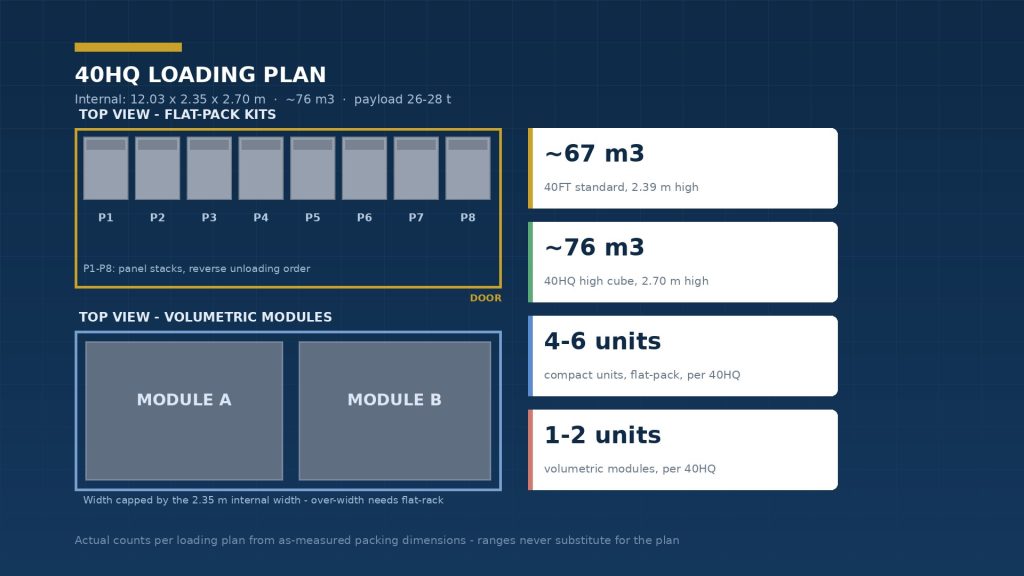
40HQ container floor plan: flat-pack panels vs. volumetric modules
Internal dimensions and payload limits of 40FT and 40HQ containers; how module dimensions, flat-pack capability, packing thickness and door-to-door method determine unit count; a loading-efficiency comparison across product forms; and why the packing plan belongs in the contract.
Slug:** `how-many-prefab-units-fit-40ft-container`
Keywords: prefab house container shipping; 40ft container loading modular
──────────────────────────────────────────────
“How many units fit in one container?” is the most-asked question in prefab house procurement, and the one most often misled by low quotes. A unit count isn’t valid just because a supplier states a number: four variables decide it, and change any one and both the count and the freight change with it. This article gives usable capacity ranges, a way to judge each deciding variable, and a loading-efficiency comparison across product forms.
1. Start with two baseline figures
Container internal dimensions are a public standard (ISO 668 / container manufacturer data):
| Container type | Internal dimensions (L×W×H) | Internal volume | Practical loading notes |
| 40FT standard | approx. 12.03 × 2.35 × 2.39 m | approx. 67 m³ | Door height approx. 2.28 m; watch height-limited pieces |
| 40HQ high cube | approx. 12.03 × 2.35 × 2.70 m | approx. 76 m³ | Door height approx. 2.58 m; most frame panels can ship upright |
The other limit that often gets overlooked is weight: a 40ft container’s maximum payload is usually 26–28 tonnes (varies with the box and destination road rules). Most prefab units hit the volume limit before the weight limit, but orders with glass curtain walls, sanitaryware and large panels should be calculated by weight first, then volume.
2. Four variables that decide the unit count
1. Module dimensions. The width of a fully assembled volumetric module is hard-limited by the container’s 2.35 m width: anything wider than 2.3 m means one unit per container, or a flat rack or platform container at several times the freight. That’s why modules built for sea freight keep their width at 2.2–2.3 m (the shipping spec of compact units like S190 (/products/s190-2/)).
2. Whether it can be flat-packed. The same house in two delivery forms can differ 2–3× in loading efficiency:
– Volumetric: finished inside the factory, craned into place on site, low loading efficiency (1–2 modules per container);
– Flat-pack / kit: wall panels, roof panels and frames stacked and bundled, so one container holds the panels for 3–6 units, at the cost of a longer on-site assembly.
3. Packing thickness. Flat-pack panels are bundled on pallets, and corner protectors, moisture barrier film and cushioning typically add 5–10 cm to each stack. Across 12 stacks that adds up to tens of centimetres: whether you fit one more unit often comes down to the packing plan.
4. Door-to-door method. Pickup at the port and door-to-door delivery place different demands on container loading. Door-to-door means a second transfer in the destination country, so panels must be loaded in reverse unloading order and the loading plan has to be worked out in advance. LCL, by contrast, is billed purely by volume, so there is no “load more to save on freight.”
3. Loading efficiency by product form
Typical ranges based on a 40HQ (actual figures depend on the measured packing dimensions of each model):
| Product form | Packaging | Typical 40HQ load | Loading efficiency |
| Compact unit (up to 19 sq m) | Knocked-down flat panels | About 4–6 sets per container | High |
| Mid-size unit (28–42 sq m) | Knocked-down flat panels | About 2–3 sets per container | Medium-high |
| Mid-size unit (as above) | Pre-assembled | About 1 set per container (in 2 modules) | Medium |
| Large module (54 sq m and up) | Pre-assembled | One module per container, multiple containers per set | Low |
| Bathroom/utility unit | Pre-assembled | About 3–4 per container | Medium-high |
The pattern is simple:The more knocked down the product, the higher the loading efficiency and the longer the on-site work. The more pre-assembled, the faster the on-site work and the higher the share of freight cost. No single form wins on both counts. You choose what fits the project.
4. Put the packaging plan in the contract: the key to avoiding shipping damage disputes
Ocean freight takes around 30 days, and the cargo inside the container goes through high humidity, salt spray and repeated handling. Packaging is not a cost line; it is a dispute clause. We recommend fixing the following in the contract:
1. Packaging layers: moisture barrier film, then cushioning material, then corner protectors and strapping on the pallet. Specify the material and thickness of each layer.
2. Loading plan: attach the loading plan agreed in the contract, with container numbers matched to panel numbers so any damage can be traced to a specific piece.
3. Inspection window: agree the process and deadline for unpacking, photographing and filing a claim within N days of arrival.
4. Fragile items list: list glass, light fixtures and sanitaryware separately, with their packaging grade and inspection standard.
Without a loading plan and packaging clauses, once damage is found at the port it is almost impossible to settle whether the factory packed badly or the shipment was mishandled. This is one of the most common deadlocks in export disputes.
For our export capability and experience at destination ports, see the About Us (/about/) page. How freight is quoted and how DDP differs from CIF are covered in tomorrow’s article on trade terms (10-28).
5. Get a loading plan
Send us your target models and quantities, and our export team will reply with a loading plan based on measured packing dimensions, the number of containers and volumetric weight, and a packaging specification list. Work out the freight before you negotiate the price.Contact Us