
S550-AZ150 Aluzinc Light Steel: Built for Both Coasts and Deserts
Keywords: aluzinc light steel structure; light gauge steel framing durability
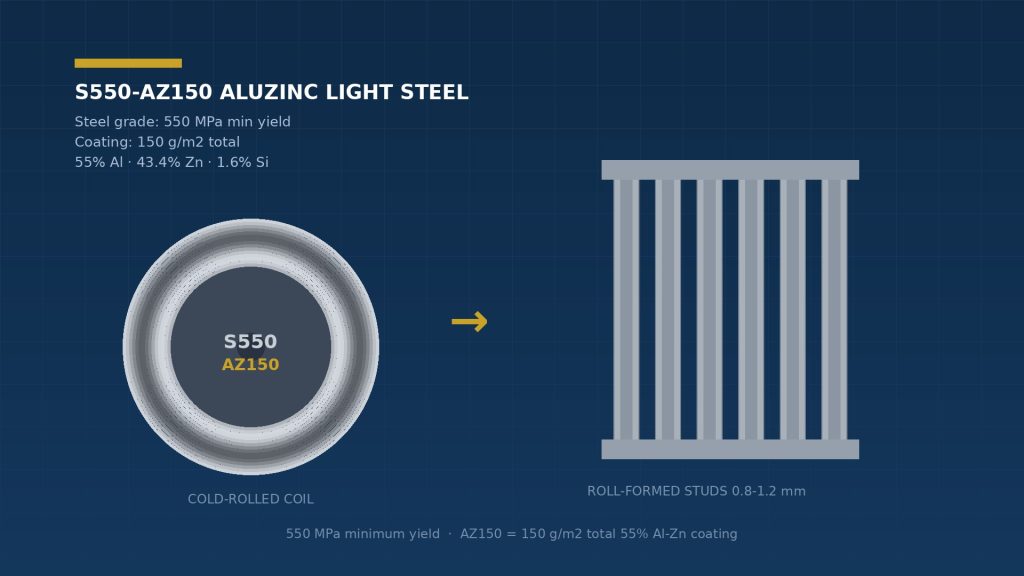
The quality of a light steel house frame comes down to two things:how strong the steel is, and how thick the coating is. Weilande uses S550-AZ150 high-strength aluzinc light steel throughout. The first code is the steel grade, the second is the coating spec. Suppliers often lump the two together, but they govern completely different things: S550 determines whether the structure can carry the load, and AZ150 determines how many years the frame survives in a given environment. This article takes them one at a time.
1. S550: a number about strength
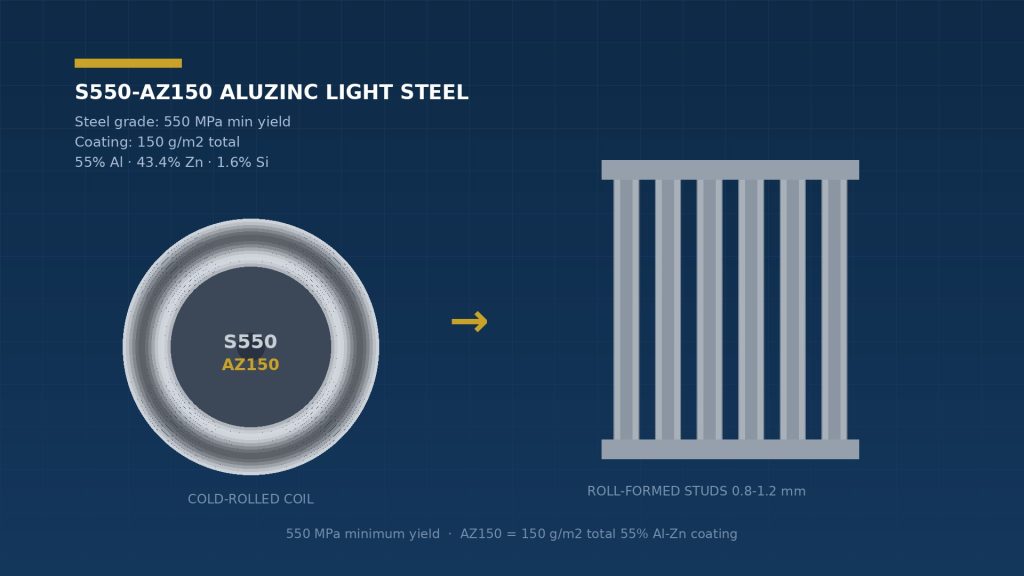
S550 (equivalent to G550 in Australian standard AS 1397 and S550GD in European standard EN 10346) refers to cold-rolled structural steel coil with a minimum yield strength of 550 MPa. For comparison: ordinary Q235 steel has a yield strength of 235 MPa, so S550 is more than double.
What does high strength mean in practice? Under the same load, you can build equally solid members from thinner steel. Light steel framing is typically 0.8–1.2 mm thick, far lighter than traditional steel structures, yet it carries more per unit of cross-section. This is the physical basis for the light steel structure’s “low self-weight, long spans, high factory prefabrication precision.”
One objective limitation to note: 550 MPa cold-formed steel has low elongation (AS 1397 requires only 2% for G550). It suits roll forming and light bending, not deep stamping. That is a property of the material, not a quality defect. Reputable manufacturers design the roll-forming passes around the forming process instead of forcing it through repeated bending.
2. AZ150: a number about coating weight
AZ150 means a total of 150 g/m² of aluminum-zinc alloy coating on both sides combined, with an alloy composition of 55% aluminum, 43.4% zinc, 1.6% silicon, produced to standards such as ASTM A792, AS 1397 and EN 10346. The coating protects in two ways:
– Barrier protection (aluminum): aluminum forms a dense aluminum oxide passivation film on the surface that blocks moisture and oxygen. This is the main reason aluzinc resists corrosion better than a zinc coating of the same thickness.
– Sacrificial protection (zinc): when the coating is scratched or the steel is sheared, the zinc at the cut edge corrodes first and protects the exposed steel substrate. This is why aluzinc self-heals at cut edges better than a pure aluminum coating.
Public industry data broadly agrees on AZ150’s corrosion resistance:at the same coating thickness, its corrosion life is about 2–4 times that of conventional hot-dip galvanizing (Z275); in rural and moderate industrial atmospheres, bare service life is commonly cited at 25 years or more. Salt spray test hours vary widely between manufacturers, so rely on the measured values in the mill test certificate (MTC) supplied with each batch, not on verbal promises.
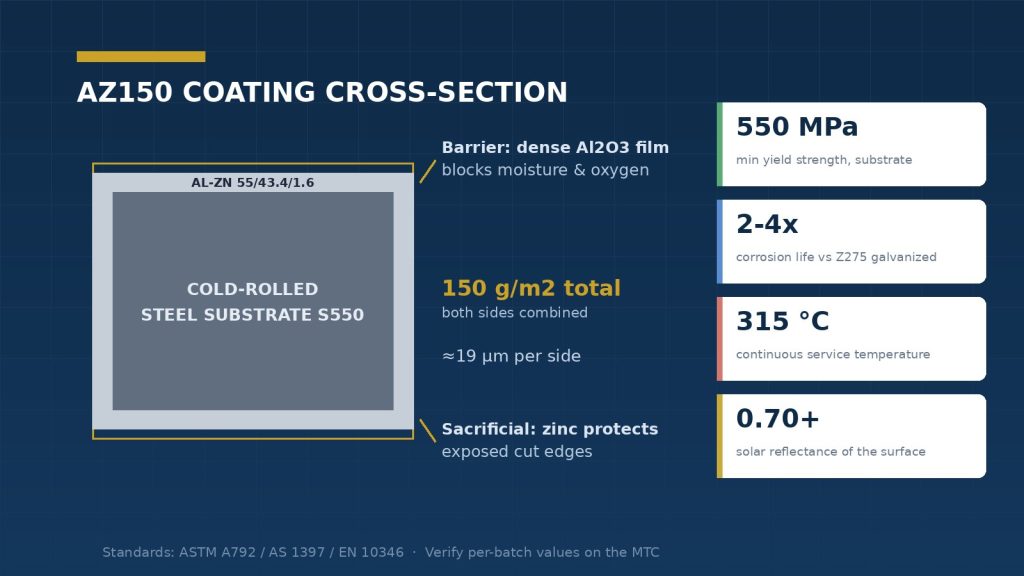
Cross-section diagram of AZ150 coating
3. Real-world performance in two extreme environments
Coastal salt-spray environments

Salt spray corrodes steel when chloride ions penetrate the coating and attack the base metal. The aluminum oxide barrier layer in Al-Zn coated steel blocks chloride ions far better than a pure zinc layer, which is why it is widely used on coastal projects. Bays, island guesthouses and seaside resorts are common applications for Welland’s S series.
That said, AZ150 is not unlimited protection: on buildings in the splash zone or very close to the shoreline (within a few hundred meters), the corrosion rating rises significantly. Standard industry practice in these cases is to upgrade to AZ185/AZ200 coating or add an organic coating. When specifying, be honest about the project’s distance from the sea.
Desert environments with extreme temperature swings
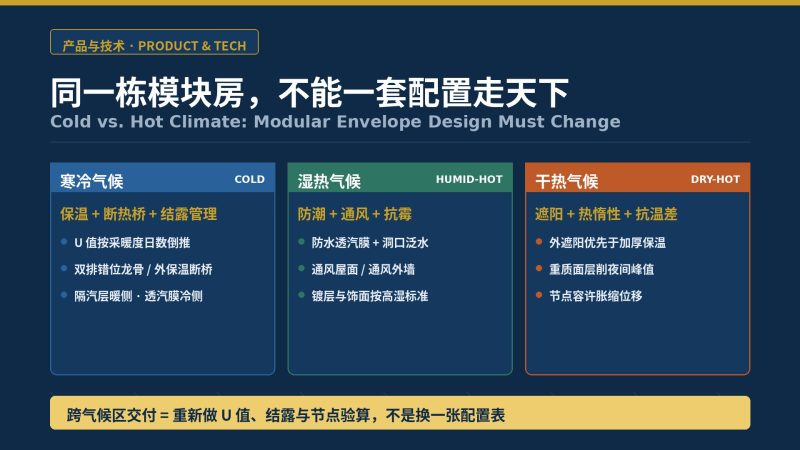
In the desert, the challenge is not corrosion but heat: day-night temperature swings can reach 30–40°C, and component surfaces get very hot in summer. Al-Zn coated steel has two objective advantages here:
1. Heat resistance: the Al-Zn layer can be used continuously at 315°C, far higher than galvanized coating, and does not soften or peel at high temperatures;
2. Heat reflection: the Al-Zn surface reflects up to 0.70 or more of solar radiation, which lowers solar heat gain when used on roofs. This is why Al-Zn coated sheet is widely used on roofs in the Middle East and North Africa.
In addition, metal coatings contain no organic matter, so there is no UV aging problem—a structural advantage over color-coated panels in high-sunlight regions (the fading risk of color-coated panels comes from the organic topcoat, not the coating itself). Light-gauge steel framing also handles temperature swings better than wood: the moisture content of steel does not fluctuate with the environment, so connections do not loosen from shrinkage and swelling the way they do in timber structures.
## 4. How to turn “durability” into verifiable contract terms
Durability ultimately has to be documented. When buying a light-gauge steel house, we recommend locking down the following four items in the contract:
| Item | What to specify | Standard |
| Steel grade | S550GD (or G550), minimum yield strength 550 MPa | EN 10346 / AS 1397 |
| Coating specification | AZ150 (150 g/m², both sides combined), 55% Al–Zn alloy | ASTM A792 / EN 10346 |
| Quality certification | MTC for each batch of steel coil, including measured yield strength and coating weight | Documents shipped with goods |
| Cut-edge treatment | Touch-up requirements for field-cut areas | Contract technical terms |
A quote that says only “light-gauge villa” without the grade and coating weight gives no way to judge the actual service life of the frame. Two products both called “light-gauge” could be one S550-AZ150 and one S250-AZ70—double the yield strength and half the coating, yet the price difference may not show up in the quote.
## 5. How Weilande does it
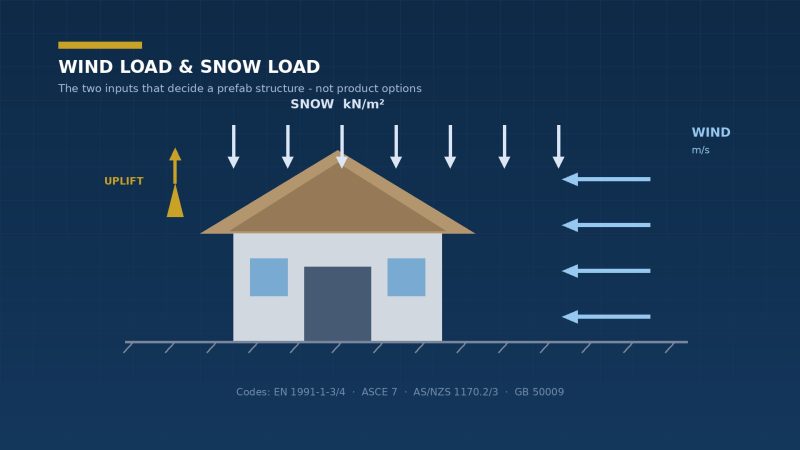
Every structural keel in a Weilande building is formed from S550-AZ150 steel coil, supplied with an MTC for each batch. Structural calculations are issued separately for each project, based on the wind pressure, snow load and seismic design parameters at the target site. Tomorrow’s article, “Wind and Snow Loads,” will cover how these are verified. Overall performance figures (wind resistance, fire resistance, seismic resistance) are listed on each product page (/products/) and apply only to the specific conditions stated; we make no absolute promises that ignore project conditions.
Need to check the steel coil grade and coating spec?Contact Us Contact our export team for a sample MTC from the latest batch and the material specification sheet.