
What S550-AZ150 means: reading the steel grade and coating on light-gauge steel modules
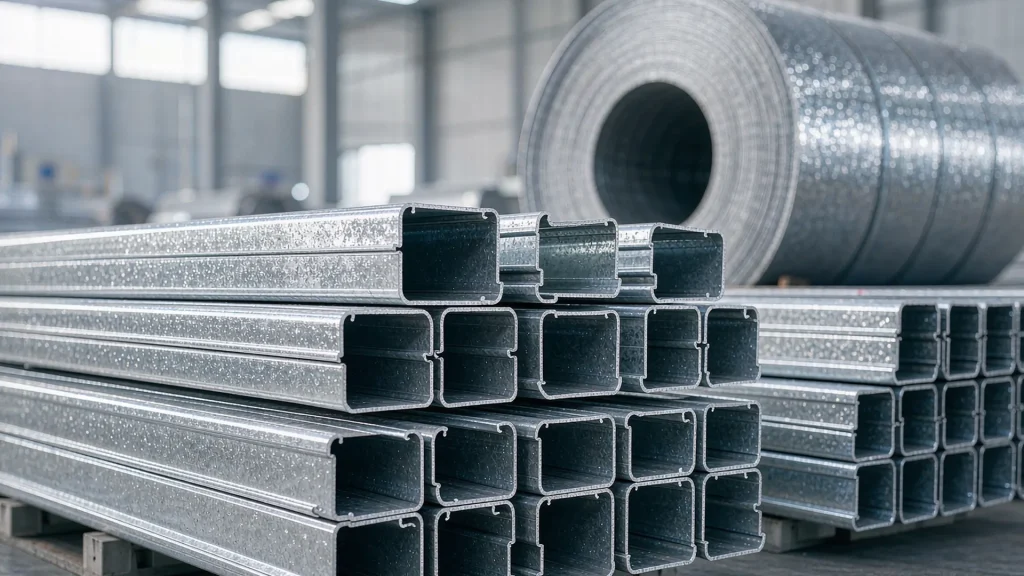
Aluzinc framing profiles with steel coils in the background — the silver-grey crystalline pattern is the spangle formed as the aluminium-zinc alloy solidifies (illustrative)
Product brochures and quotes often list “S550-AZ150” in the materials column, and buyers usually care about just two things: is it strong enough, and will it rust? The code answers both on a single line — the first half is the steel grade, which governs load capacity; the second half is the coating code, which governs service life. Break it down and you can read it in a minute.
1. The first half: S550GD is the steel grade, and 550 is the yield strength
S550GD is a structural steel grade in EN 10346 (continuously hot-dip coated steel sheet and strip), and each of its four characters carries one piece of information:
| Character | Meaning | What it means for a module |
| S | Structural steel | Designed as a load-bearing member, not as cladding or a general formed part |
| 550 | minimum yield strength of 550 MPa | Tensile strength of about 560–680 MPa; thinner walls can carry the same load |
| G | Suitable for cold forming | Can be roll-formed into C and U profiles, suited to automated production lines |
| D | Hot-dip coated | The strip passes continuously through the coating bath on the line, giving more uniform coating than batch galvanizing |
The value of the number 550 is weight savings. Ordinary structural steel (such as S250GD) has a yield strength of about 250 MPa, so carrying the same bending moment would require double the wall thickness. With 550 MPa steel, members are thinner and lighter — module dead weight drops, and with it the weight inside shipping containers, the lifting equipment required, and the foundation loads. This is the material basis that lets light-gauge steel modules be “light”.
The trade-off is two things. First, thin-walled high-strength members are more sensitive to local buckling, and cross-section shape (stiffening lips, ribs) determines load capacity more than wall thickness does, so design must follow the rules for cold-formed thin-walled members rather than borrowing experience from hot-rolled steel. Second,elongation is relatively low(A80 typically not below 10%): roll forming and moderate bending are fine, but deep drawing and sharp bends are not — which is also why module framing joints rely mostly on screws, blind rivets and connectors rather than on heavily bent steel sheet.
2. The second half: AZ150 is the coating code, and 150 is the total weight on both sides
AZ150 is often misread as “coating thickness 150”. It actually means coating weight: 150 g/m² total for both sides, or about 75 g/m² per side. At the roughly 3.7 g/cm³ density of 55% aluminium-zinc alloy, that works out to about 20 µm per side. AZ indicates that this is not pure zinc but an alloy coating of about 55% aluminium, 43.4% zinc and 1.6% silicon.
Each of the three elements does one job:Aluminium forms a dense aluminium oxide film on the surface that acts as a barrier against atmospheric corrosion;Zinc provides sacrificial protection at scratches, cut edges and holes, corroding itself first;Silicon It looks like the least important ingredient, but its job is to stop brittle intermetallic compounds from growing too much between the coating and the steel base. Without it, the coating tends to flake and crack during roll forming.
One boundary worth stating clearly: At the same coating weight, aluminum-zinc coatings are typically reported to last 2–4 times longer than pure zinc in industrial, rural and marine atmospheres, and they also perform better on heat resistance and heat reflection (reflecting about 75–80% of solar radiation). But their cut-edge sacrificial protection is weaker than pure zinc: the steel exposed at cut edges does not self-heal as fully as it would with pure zinc. So cut edges and openings in long-exposure areas need edge sealing or a coating treatment, which matters especially on coastal projects with high salt fog.
3. Why lightweight steel modules favor this combination
- Strength buys weight savings. At 550 MPa, walls can be 0.8–1.2 mm thick and still carry the load, so total module weight stays manageable and freight and lifting costs come down.
- The coating buys service life. AZ150 gives a long enough maintenance cycle in most atmospheric environments, and formed parts need no second galvanizing, which avoids the high-temperature distortion of hot-dip galvanizing.
- Formability suits automation. Continuous hot-dip coating, a substrate suited to cold forming and silicon-controlled coating ductility: only all three together deliver steady output on high-speed roll forming lines, which is the prerequisite for modular mass production.
- Appearance and thermal performance. The silver-gray spangle surface can serve as a finished face (exposed-structure style), and its heat-reflective properties help keep roofs and exterior walls cooler.
4. How buyers verify: three steps
- Check how the grade is written on the material certificate. The EN 10204 3.1 mill certificate for the steel coil should state the full grade and coating designation (e.g. S550GD+AZ150) with a traceable heat number. Equivalent designations under other standards: EN 10346, ASTM A792/A924, JIS G3321, GB/T 14978. Whichever standard the supplier uses, they should be able to explain the correspondence.
- Verify coating weight, not just “it’s galvanized.” AZ150 is a measurable number of grams, not an adjective. Ask for coating weight test data (weigh-strip or instrument method) and check it matches the order. A certificate that only says “aluminized zinc” or “anti-corrosion treatment” says nothing.
- Check coating integrity after forming. After roll forming, the outer flange faces and hems should show no coating flaking or micro-cracks. Whether cut edges and openings have been sealed is the most direct sign of how mature the process is.