
The EU Digital Product Passport Is Here: What Modular Exporters Need to Prepare Now
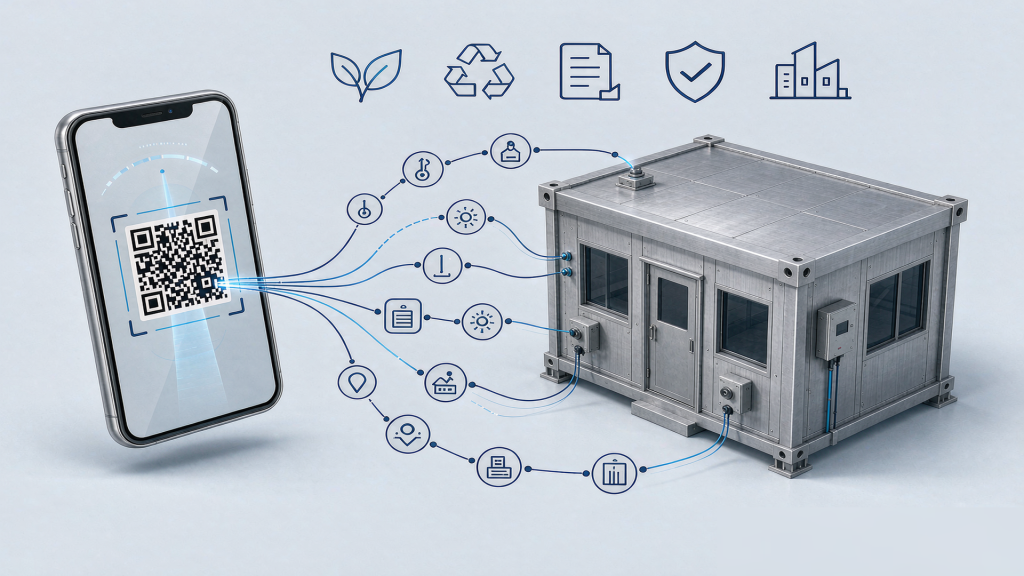
The EU Digital Product Passport and Modular Construction: Scan a Code, Read the Material Data
If you export modular buildings to Europe, the Digital Product Passport (DPP) will be the single biggest compliance change of this decade. The regulation that created it, the Ecodesign for Sustainable Products Regulation (ESPR) (EU) 2024/1781, entered into force on 18 July 2024. The official EU timeline puts the delegated act for construction products in Q2 2027, and after a transition period of at least 18 months, the mandate lands around 2028-2029. You do not need a finished passport today, but you do need the data pipeline behind it in place. Companies that start preparing in 2026 and companies that scramble at the last minute will have two very different export experiences when the deadline arrives.
1. What exactly is a Digital Product Passport?
A Digital Product Passport is a structured digital record that follows a product through its entire life cycle. In the European Commission’s official definition, the DPP is a “digital container” for information on a product’s components, materials and chemical substances, used to support sustainability, advance circularity and strengthen legal compliance. In practice, a user scans the data carrier on the product, usually a QR code, and reads the registered information linked to the product’s unique identifier. All of that data is anchored in the EU’s single DPP Registry, which went live on 20 July 2026 and is now the EU’s only registration entry point.
Every exporter should remember three key points on this timeline:
| Milestone | Date | What it means for exporters |
| ESPR (EU) 2024/1781 enters into force | 2024-07-18 | The legal basis for the DPP, replacing the original Ecodesign Directive |
| DPP Registry goes live | 2026-07-20 | Single registration entry point; batteries apply first (2027-02-18) |
| Delegated act for construction products | Expected Q2 2027 | Sets out exactly which data construction products must disclose |
| DPP mandatory for construction products | Expected 2028-2029 | At least 18 months of transition after the delegated act |

Overview of DPP data requirements for construction products
Batteries will be the first product category required to carry a DPP (18 February 2027). Construction products, which cover modular buildings, come next, because the revised Construction Products Regulation (EU) 2024/3110 already requires a DPP strategy for CE-marked products. The exact data fields will be settled by the 2027 delegated act, but the direction is already clear from the ESPR working plan and the six CEN-CENELEC DPP standards published in May 2026.
Three common misconceptions are worth clearing up now. First, a DPP is not a PDF attachment: it is structured, machine-readable data held in a registry, so the “email the certificate pack” approach will not meet the requirement. Second, it is not just an environmental report. Structural safety, durability and hazardous-substance compliance data all fall within the disclosure scope. Third, responsibility follows the economic operator: for imported buildings, EU importers will pass the “passport-grade data” requirement down to non-EU manufacturers through contracts. In other words, even if the delegated act does not name you yet, the obligation has effectively landed on your desk. Preparing for these three things in 2026 costs far less than scrambling to fix them in 2028.
2. What data does a modular building passport need?
A data chain cannot be reconstructed after the fact; it can only be generated alongside production. Based on the ESPR working plan, the European Commission Joint Research Centre’s data specification methodology (JRC145830, March 2026) and current EN 15804 EPD practice, export manufacturers should have at least the following six categories of data ready:
| # | Data category | Example in a modular house | Source documents to prepare |
| 1 | Material composition | Steel grade S550-AZ150, coil thickness 0.8-1.2 mm | Steel mill quality certificate, bill of materials (BOM) |
| 2 | Material origin | Steel mill information, country of smelting | Supplier declaration |
| 3 | Environmental impact | Embodied carbon (kgCO2e/m2) | EN 15804 Environmental Product Declaration (EPD) |
| 4 | Recycled content | Share of recycled steel and recycled aluminium | Supplier certification |
| 5 | Hazardous substances | REACH/SVHC screening results | REACH compliance report |
| 6 | Durability and end of life | Design life, disassemblability, recyclability | Technical file, EN 1090 records |
The key takeaway here is that every item in the table above already exists somewhere in your supply chain. It is just scattered across PDF certificates, email threads and supplier folders. What you need to do now is consolidate that data into a structured, exportable format (machine-readable BOMs, batch-level traceability, one EPD per model), not run new tests. Companies that start sorting out their data in 2026 will only need to treat the delegated act as a rubber-stamping step when the time comes. Companies that wait until the deadline will find themselves doing “data archaeology” across five years of shipping records.
3.Weilande’s answer: build passport data into the product, not stick it on afterwards
At Weilande, we made the call early: DPP readiness has to be built into production, not assembled into a binder. Our 8,000 sqm factory runs modular units on aluzinc steel from a single grade (S550-AZ150), with controlled coil sourcing, so material composition and origin can be traced batch by batch. CE marking and EN 1090 execution class documentation, EN 13501 fire ratings, and REACH screening reports are already structured by model. In other words, the most important columns in the future passport template are already filled in today.
For buyers, this changes how the negotiation goes. You no longer have to ask, “Will you be compliant by 2028?” You can browse our product range, review delivered modular projects, and pull the supporting documents at any time. When the Construction Products Authorization Act takes effect in 2027, our products will upgrade directly from existing data into a full DPP, and your import clearance paperwork will be ready at the same time. Get in touch to request a material data sheet and see what a passport-ready data record looks like.