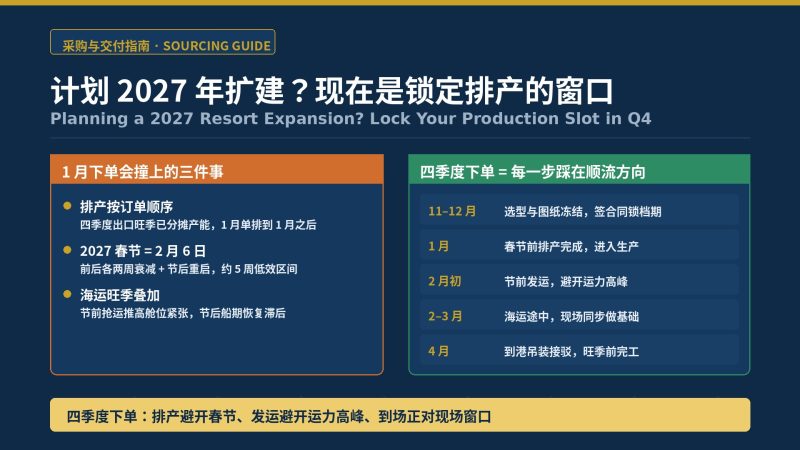

Chinese New Year 2027: the production and shipping calendar overseas buyers need to know
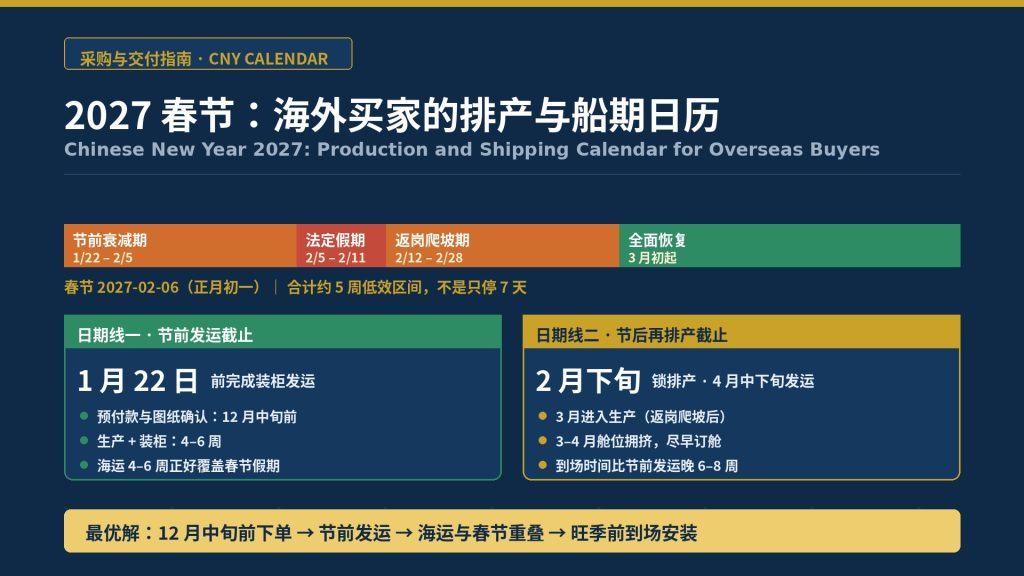
The short version:Chinese New Year 2027 falls around February 6 (Saturday, the first day of the lunar year). But the impact on Chinese factories and ocean freight runs far beyond the official holiday. What you actually need to plan around is a roughly five-week stretch of reduced capacity on either side.
Note: the date ranges below reflect general patterns in manufacturing and ocean freight. Actual schedules at each factory and port depend on your supplier’s written production schedule and the carrier’s announcements.
1. What Chinese New Year really does to supply chains: five weeks, not seven days
Laid out on a timeline, the impact breaks into four phases:
Phase 1: the pre-holiday slowdown (roughly January 22 – February 5). Workers head home gradually, so output falls day by day over the last two weeks. At the same time, every industry is rushing orders out the door, so carrier space is tightest and rates are highest. Book trucking and container space two to three weeks ahead.During this stretch, being able to produce does not mean being able to ship. Production is easy; space is hard.
Phase 2: the official holiday (roughly February 5 – February 11). Everything stops. Production lines, freight forwarders, customs brokers and destination agents all run on the Chinese calendar.
Phase 3: the ramp-up as workers return (roughly February 12 – February 28). Work resumes gradually after the eighth day of the new year, but it takes one to two weeks for attendance, the supply chain (steel, insulation core materials, hardware) and QC and packing crews to get back to full capacity.
Phase 4: full recovery (from early March). Only then do production and shipping return to normal, roughly five weeks after the holiday began.
2. Two dates you can plan around right now
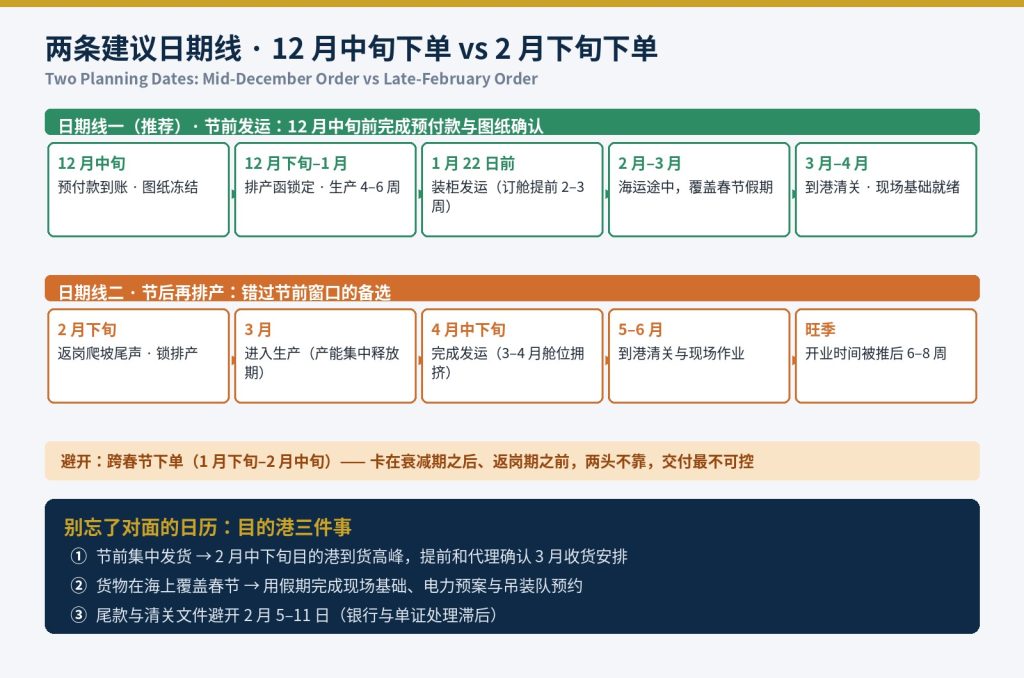
Two date lines side by side: ship before the holiday (recommended) versus schedule production after it, and why you should avoid placing orders across Chinese New Year
Date line one: the pre-holiday shipping cutoff. Aim to finish loading containers and ship by January 22.
Working backward: to get cargo out of port before the holiday, and given that space is tightest in early February and must be booked two to three weeks ahead, the safe deadline for finishing loading is January 22. Add the four-to-six-week production cycle before that:Deposit payment and drawing approval need to be done by mid-December to guarantee pre-holiday shipping.
Shipping before the holiday pays off twice: you avoid the slow post-holiday recovery in sailing schedules, and the four to six weeks your cargo spends at sea covers the holiday itself, so it arrives ready for customs clearance and site groundwork.Ocean transit overlapping the holiday means no time wasted.
Date line two: the post-holiday production cutoff. Aim to order in late February and ship in mid-to-late April.
If you miss the pre-holiday shipping window, the next realistic one opens after the holiday: lock in your production slot in late February (as workers finish returning to their posts), start production in March, and complete shipping in mid-to-late April. The risk with this route is that March–April is when shipping space and production capacity are released in a post-holiday surge, so both quotes and schedules need to be locked in early.
Ordering across the Spring Festival, between these two routes, is the worst option: the order lands after the slowdown and before workers return, fitting neither window, and actual delivery timing becomes the least predictable.
3. At the destination port
The Spring Festival doesn’t only affect the China side:
- Destination customs clearance and trucking: Concentrated pre-holiday shipments mean cargo arrives at the destination port in a wave in mid-to-late February, with agent warehousing, trucking and inspections all queuing at peak. Confirm March receiving arrangements with your destination agent in advance;
- Prepare the site at the same time: Since the cargo will be at sea during the Spring Festival holiday, use this time for site groundwork, power connection plans and crane crew bookings, so installation can begin as soon as the goods arrive in April;
- Payment and document timing: Banks and document processing run slow during the holiday, so schedule final payments and customs clearance documents to avoid the February 5–11 window.
4. Weilande’s Spring Festival production schedule
- Rank pre-holiday orders in November–December: Prioritize pre-holiday shipments for orders in hand by the order in which deposits are received, and issue a written production schedule;
- Put the pre-holiday shipping deadline in writing: State the target container-loading completion date and booking responsibility in a contract appendix; no verbal promises;
- Stay in touch during the holiday: Keep a project contact on hand during the holiday for urgent matters, and resume production per the production schedule as soon as the holiday ends;
- Deliver on the production schedule after the holiday: Capacity reserved for the return-to-work ramp-up was already deducted when scheduling in November–December, so customers don’t get the surprise of another postponement after the holiday.
If your 2027 project plan is already set, placing orders and confirming drawings by mid-December is the best way to overlap sea freight with the Spring Festival holiday and have the equipment on site and installed before peak season. Send us your target opening date, and we’ll give you a concrete production and shipping plan based on the two date lines.Contact Us